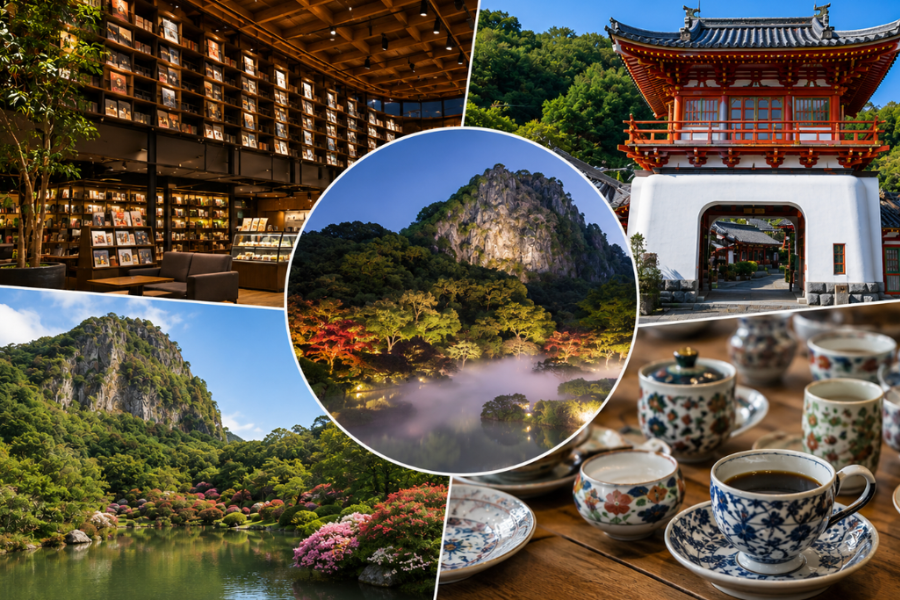
For a 2-day trip to Saga, we recommend an itinerary that goes beyond just hot springs or pottery, letting you enjoy a refined, mature sense of style. On Day 1, explore the Takeo Onsen area, including Takeo City Library and Mifuneyama Rakuen. On Day 2, enjoy Arita’s pottery townscape and cafés.
Day 1: A Day to Enjoy Takeo’s Stylish Hot Spring Town Atmosphere and Garden Art
Day 1 is all about enjoying Takeo, one of Saga’s quieter yet memorable destinations. By visiting the refined atmosphere of the library, the retro charm of the Romon Gate, and then Mifuneyama Rakuen, you can spend a satisfying day that feels elegant without being overly flashy.
10:00 Arrive at Takeo-Onsen Station
Your trip begins at Takeo-Onsen Station. The main sightseeing spots around the town are relatively close to the station, so even on a 2-day trip, you can explore without feeling rushed. First, head to one of Takeo’s symbolic spots for books and architecture.
10:30 Takeo City Library
The first place you will want to visit is Takeo City Library. Open from 9:00 to 21:00, it is known as a new style of library with a Starbucks and bookstore inside. Its spacious wooden interior and tall bookshelves are impressive, making it feel less like a place just for reading and more like a sightseeing spot where you want to spend time. The architecture itself is worth seeing, and photos here capture a warm, stylish atmosphere.
12:00 Lunch
Kyushu Pancake Cafe Takeo City Children’s Library Branch
If you want a light lunch, “Kyushu Pancake Cafe Takeo City Children’s Library Branch” is a convenient choice. The space has a soft and gentle atmosphere, so you can enjoy a meal while still feeling the library’s calm ambience. It is a good match for Takeo’s relaxed mood.
14:00 Stroll Around Takeo Onsen Romon Gate
In the afternoon, head to the area around Takeo Onsen’s Romon Gate. Takeo Onsen is a hot spring town with more than 1,300 years of history, and its symbolic Romon Gate was completed in 1915. It was designed by Kingo Tatsuno, who is also known for designing Tokyo Station. Its vivid red exterior leaves a strong impression and stands out as one of the most photogenic spots in the hot spring town. This is a tasteful historic spot that should appeal to fans of retro scenery and architecture.
15:30 Mifuneyama Rakuen
Next, visit Mifuneyama Rakuen. This large garden, created in the late Edo period, covers about 500,000 square meters. In addition to seasonal flowers and trees, one of its biggest attractions is the impressive scale created by the rocky surface of Mount Mifune in the background. The garden alone is worth seeing, but depending on the season, art installations such as teamLab’s “A Forest Where Gods Live” may also be held, allowing you to experience a dreamlike space where nature and digital art overlap. During the day, you can enjoy the power of greenery and rock formations, while at night, the atmosphere changes completely with light installations.
17:30 Café Break or Hot Spring
EN TEA HOUSE Genkatei
If you want to keep enjoying the afterglow of Mifuneyama Rakuen, “EN TEA HOUSE Genkatei” is highly recommended. It is known for its experiential presentation, where flowers appear to bloom inside the tea, making it different from an ordinary café. Art and tea come together here, giving you a unique café experience.
Stay Overnight at Takeo Onsen
For accommodation, staying overnight in Takeo Onsen is recommended. It offers good access from the library and Mifuneyama Rakuen, and at night, you can enjoy the calm atmosphere of a traditional hot spring town. Consider it as part of the experience, including the mood of the onsen area itself.
Day 2: A Day to Enjoy Arita’s Pottery Town and Café Time
Day 2 is about exploring Arita, a place where you can feel a sense of style just by walking around. By connecting the Tonbai wall alleys, pottery shops, and modern Arita ware cafés, you can discover the charm of Arita beyond simple shopping.
11:00 Stroll Around Arita Uchiyama District
In the morning, head to Arita’s Uchiyama district. As a pottery town, the area is lined with pottery shops and old townhouses, and the Tonbai wall alleys are especially great for feeling the unique character of Arita. These distinctive walls are made by solidifying fireproof bricks, kiln tools, pottery fragments, and other materials with red clay, creating scenery you can only photograph here. It is not a flashy tourist destination, but that is exactly why pottery lovers, architecture fans, and people who enjoy town walks should visit.
12:30 Lunch
Gallery Arita
If you want to enjoy a meal or café time in a space that feels truly Arita-like, “Gallery Arita” is recommended. It is known for being surrounded by about 2,500 Arita ware coffee cups, and when you order a hot drink, you can choose your favorite cup. You can enjoy not only the meal, but also the experience of choosing your own piece of pottery, making it a memorable stop.
ARITA PORCELAIN LAB Cafe
If you prefer a more modern atmosphere, “ARITA PORCELAIN LAB Cafe” is also a good choice. You can enjoy dishes and drinks made with local Arita ingredients, served on contemporary Arita ware, allowing you to experience traditional craft through food. The combination of the food and tableware also looks beautiful in photos, which is another reason to recommend it.
14:00 Arita Séra or Continue Walking Around Town
In the afternoon, extending your trip to Arita Séra is also recommended. It is a large Arita ware specialty mall with 22 stores spread across a site of about 66,000 square meters, where you can browse everything from everyday tableware to gifts and high-end art pieces. It is ideal for those who want to shop at a relaxed pace, while those who prefer town walking can continue visiting individual shops in the Uchiyama district. You can enjoy both “pottery to admire” and pottery you can actually buy.
17:00 Head Home
Arita is not the kind of tourist destination that feels flashy or overly lively, but that is exactly what makes it easier to find something you can take home as a personal travel memory. The flow connecting the calm atmosphere of Takeo’s hot spring town with Arita’s craft culture makes for a highly satisfying itinerary.
Summary
The appeal of this trip is that you can smoothly combine Takeo’s stylish hot spring town atmosphere with Arita’s pottery town walk into one itinerary. If you want to enjoy not only sightseeing spots, but also a library, garden art, a historic gate, and pottery cafés, use this course as a reference.